

Health Centre Labourdonnais
Health Centre Labourdonnais is a brand transformation project addressing a critical challenge of identity erosion within a competitive healthcare environment.
Originally operating as CARE, a discreet paramedical and wellness centre established in 2018, the centre progressively lost perceptual ownership of its location following the acquisition of neighbouring medical units by a larger healthcare group. Despite maintaining its independence and quality of care, patient perception gradually shifted—associating the entire precinct with the dominant external brand.
Rather than approaching this as a cosmetic rebrand, the project was framed as a territory reclaim exercise. The objective was to restore spatial, digital, and perceptual authority by aligning brand architecture, physical wayfinding, content strategy, and digital experience.
The result was a cohesive transformation that re-established Health Centre Labourdonnais as the primary wellness destination within the precinct, while preserving patient trust and enabling measurable growth across digital channels.
My Role
I led the project from strategic framing to execution, overseeing:
- Brand implementation and collateral alignment
- Spatial UX and wayfinding strategy
- Digital ecosystem re-architecture (UX, SEO, CRO)
- Content systems and practitioner positioning
- Launch readiness, analytics, and performance tracking
I worked closely with the Head of Marketing, centre coordination team, internal designers, and external partners to ensure alignment across all touchpoints.
The Team
Head of Marketing (Strategic oversight)
Centre Coordinator (Operational alignment)
Internal Graphic Designer (Brand identity)
Interior Designer (Reception redesign)
External Graphic Designer (Wayfinding system)
Web Development Agency
PR & Communications Coordinator
Signage Production & Installation Partner
Timeline
- Brand transition approval: ~4 months
- Website rollout, reception redesign & signage installation: < 3 months
Total transformation period: ~7 months
The Challenge
The core challenge was not visibility alone—it was loss of territory. Following the integration of neighbouring medical units into a larger healthcare group, the former CARE centre became physically embedded within a stronger brand presence. Over time, visitors increasingly perceived the entire location as belonging to that group, unintentionally erasing CARE’s identity.
The risks were significant:
Brand dilution
Reduced destination clarity
Long-term invisibility despite operational continuity
Any intervention had to restore authority without triggering patient confusion or loss of trust, a critical factor in healthcare environments.




The Strategic Reframe
The project was reframed from a “rebrand” to a territory reclaim strategy. Rather than competing visually with neighbouring brands, the objective became to:
Reassert ownership of the location
Anchor the centre clearly within the Labourdonnais ecosystem
Align physical space, content, and digital behaviour into a single narrative
This reframing guided every subsequent decision—from spatial design to UX architecture.
The Process
1. Brand Translation & Identity Alignment
Following approval of the new name, logo, and colour palette, all collaterals were systematically rebranded. The approach prioritised continuity over disruption, clearly communicating that while the identity evolved, the care, practitioners, and values remained unchanged.
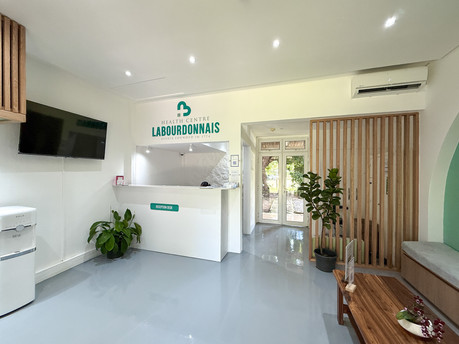
2. Reception & First-Contact Experience
The reception space was redesigned to embody calm, professionalism, and trust—key emotional cues in healthcare settings.
Working with an experienced interior designer, the Head of Marketing, and the Centre Coordinator, we ensured the physical experience aligned with the new brand positioning and reassured patients at the first point of contact.


3. Wayfinding as Behavioural Strategy
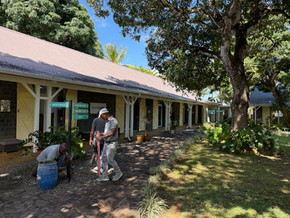
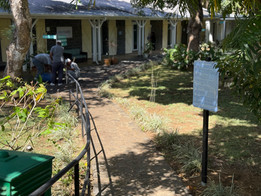
A pivotal decision was to redefine the entire medical precinct as Health Centre Labourdonnais territory.
I mapped the full patient journey—from parking areas to reception—identifying perceptual friction points and ambiguity. Wayfinding was designed not as signage decoration, but as behavioural guidance, subtly repositioning the centre as the primary destination and situating all surrounding medical units within its context. This strategic inversion shifted how visitors interpreted the space without confrontation or brand conflict.




4. Digital Ecosystem Re-Architecture
In parallel, the digital presence was rebuilt to reinforce the physical repositioning.
I conducted:
A brand audit
A content audit
A behavioural flow analysis of the former website

Based on these findings, I defined a new site structure focused on:
Clear entry points
Reassuring content hierarchy
Multiple conversion paths regardless of navigation route
Practitioner profiles were SEO-optimised and humanised through professional portraits and structured bios. Practitioners were invited to contribute expert articles, forming the foundation of a long-term content and social strategy.
UX and CRO improvements included:
Clear CTAs
WhatsApp direct contact
Reduced friction for appointment-related queries
A corporate brand video was produced using existing footage and deployed across the website and social platforms.
5. Launch Readiness & Measurement
To support the brand reveal:
A digital press kit was created via a dedicated landing page
A curated image library was prepared for media
QR-based referral cards were designed for medical professionals


A data framework was implemented to track digital interactions across platforms.
Together with the Social Media Coordinator, a phased digital campaign was rolled out:
Brand transition and reassurance
Visibility and awareness growth via Instagram and Facebook
Outcome & Results
Within the first two months of rollout:
Monthly website traffic increased from ~250 to over 4,000 visits
The centre successfully reclaimed perceptual ownership of its location
Patient trust was maintained throughout the transition
The project also laid the groundwork for future scalability, including automated booking, direct messaging, and digital payment systems.
Reflection / Takeaway
This project reinforced a key principle:
In healthcare, branding is never cosmetic. Effective transformation requires aligning space, behaviour, content, and digital systems into a single, coherent experience—one that restores authority quietly and sustainably. Health Centre Labourdonnais stands as a case study in how strategic brand architecture and digital leadership can reclaim territory, protect trust, and unlock long-term growth.
If you’d like to connect, collaborate, or simply exchange ideas, feel free to get in touch.


